Louis Joel Gallery Altona Melbourne
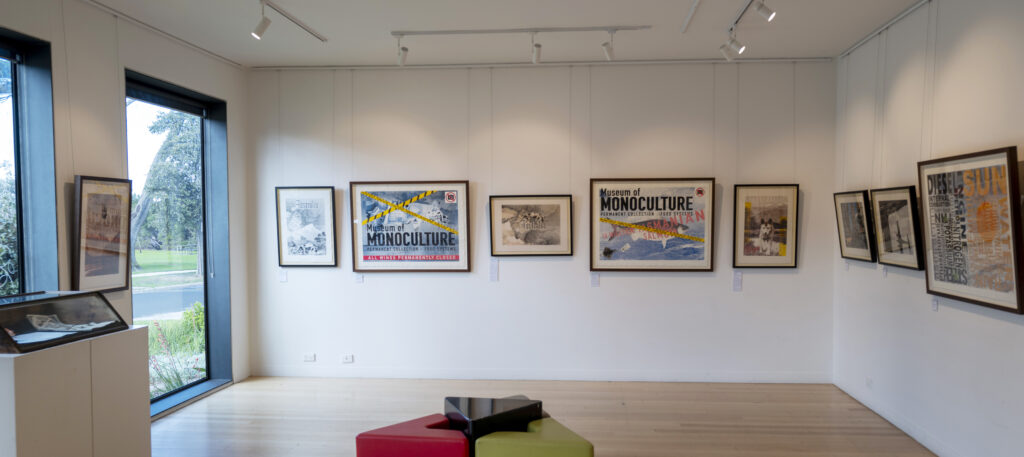
The latest exhibition for the Museum of Monoculture has opened at the beautiful, light filled Louis Joel Gallery in the Port Phillip bayside suburb of Altona, Melbourne. It is running from 30 May to 24 June 2026.
Altona is an interesting site for the Museum of Monoculture exhibition. Once home to a small community of local Maltese fishermen and farmers, after World War II the proximity to the bay, the flat terrain, and available land made Altona the perfect site for heavy industry. Petrochemical plants, oil refineries and chemical manufacturers moved in and transformed the area into one of Australia’s most significant industrial corridors in the postwar decades. More recently, industry has subsided, giving way to Melbourne’s westward suburban expansion.
Louis Joel grew up on a local dairy farm, and rode his horse over to school in Williamstown each day in the first decades of the 20th century. He graduated in medicine from the University of Melbourne and after travelling abroad, started the Altona community hospital (1938-1996) on the site that is now home to the Louis Joel Arts and Community Gallery and Ceramic Studio. The centre is a lively community run hub with a working studio, small shop, meeting rooms and community seed bank. If you visit on Sunday morning, the gallery is flooded with voices from the incredible African Choir that meets in the adjoining rooms.
The exhibition includes five new works, three are large scale landscape screen prints 108 x 78cm on paper. These look at industrial systems from Haber-Bosch to Tasmanian Salmon, venturing into the “No Photography” zone of modern food production. How is it as a society, we have designed a food system that is illegal to capture on camera?
The work “Skate Vs Salmon” is inspired by Richard Flanagan’s book Toxic ( 2021) that documents the dark side of the salmon industry, where 18 million salmon are now swimming around in crowded pens within the once pristine oceans of Tasmania. These CAFO’s (Concentrated Animal Feeding Operations) are dependent on petrochemicals and antibiotics, polluting the ocean and contaminating the local wild food resources. The salmon are fed with synthetic astaxanthin, a colour agent that transforms their unappealing factory-grey flesh into a familiar salmon-pink hue [shade #33]. A petrochemical additive, it is not approved for human consumption – falling through a legal loophole as the salmon consumes it first, we don’t know what impact this has further up the food chain. With up to four times more fat than wild caught salmon, and relatively low omega 3 levels, the fish is not only an ecological and ethical problem. Tasmanian salmon? No thanks.
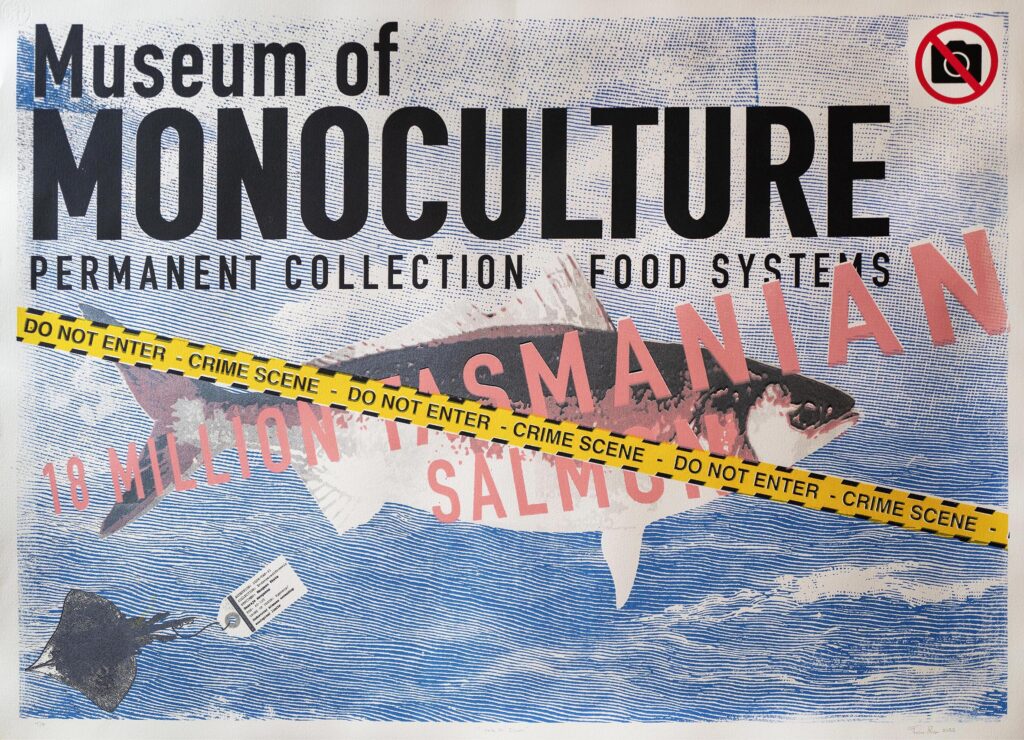
SKATE VS. SALMON 2026 Photomontage screen print on Hahnemuhle printmaking paper 300gsm 106 x 78cm. There are between 40 and 120
Maugean skates left in the wild, the remaining population is dying of hypoxia in the contaminated waters of Tasmania’s Macquarie Harbour.
The Gallery is open Tuesday-Sunday, 5 Sargood St Altona VIC 3018 in the Port Philip Bay – The artist is on gallery duty 11am to 2pm Sundays and would love to see you there!
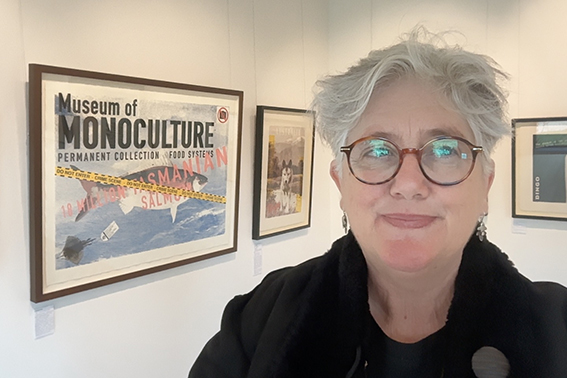
Artist Justine Philip, June 2026 at Louis Joel Gallery